Showing posts with label Museums. Show all posts

Wednesday, April 23, 2014

Guest Post: Eric Goes "Behind the Lines" at the National World War II Museum

Editor's Note: This is a guest post from Eric Muirhead about our recent trip to the National World War II Museum in New Orleans, Louisiana. You can read my review of our 2012 visit to that museum here.

As the culminating event in my post-Afghanistan leave, I was able to convince my better half to indulge me on a three day stop in New Orleans, Louisiana as it lay about half way between Disney World and our return to Killeen. The primary reason for this visit is that I have been very anxious to try the new “Behind the Lines” experience currently being offered by the National World War II Museum. However, since my wife is both a public historian and an aspiring World War II buff herself, it didn't take much effort on my part to convince her to go along. One of the highlights of the tour is access to artifacts and parts of the museum not normally available to the general public.


Though the trailer for the tour (yes, there is a trailer) went into great detail about the features of “Behind the Lines” I was still unprepared at just how much access we would be treated to upon our arrival at the museum. Since I’m sure that “Behind the Lines” is something that many of my friends and family would be interested in attending,I've decided to write a detailed breakdown of our itinerary and my reflections.

I would be remiss not to mention that “Behind the Lines” is NOT for the casual tourist looking for a few hours to kill. It is only offered on Fridays and the cost is $395 per person (or $750 a couple) and includes 12 hours of experiences at the museum including what amounts to concierge service from the wonderful travel and conference staff during the visit, personalized guided tours from the volunteer docents, and one and one time with a member of the curator staff. You also receive two meals from the fantastic in-house restaurant, The American Sector, tickets to the two multimedia experiences currently offered at the museum, “Final Mission” and “Beyond All Boundaries,” and finally seating at the evening show offered at the Stage Door Canteen (in this case, “The Andrews Brothers,” a musical review of popular USO music).

In the week prior to our tour, we received an e-mail from Molly Bergeron, Sales Manager, who would be our overall Point of Contact for the visit. She let us know who would be accompanying us on the tour and also a few questions to help personalize our visit. Ahead of time, the museum wants to know what interests you have in the World War II history, what family connections you have with the Second World War, and what connections your home-town had to the conflict so the docents could include more personally relevant information to their presentations.

This led to a discussion between Annie and me as to what this meant for the tour. I admit, rather cynically, I hoped this meant that “Behind the Lines” would be what I like to term as a “Graduate Level” experience. Too often, when I visit World War II themed attractions, I get the standard “The U.S. entered World War II when the Japanese attacked Pearl Harbor on December 7, 1941, etc. etc.” Though this is important, as someone who literally strives to learn something new and fascinating about World War II every single day, 101-level information gets a bit boring and redundant. We did end up covering the basics again, but I am pleased to say, I wasn't at all disappointed.

Also included in Molly’s packet were our complete itinerary, museum information, and instructions to arrive at the main lobby promptly at 9:00 am. As both a Soldier used to “ten minutes prior to ten minutes prior” and someone who was excited as a six year old on Christmas morning, Annie and I arrived around 8:30. Though the main museum was not open, the soda fountain/coffee shop adjacent was and we were able to have a light breakfast while we waited for the other members of our tour to arrive.

Right at 9:00, Annie and I met the other eight members of tour group and Molly Bergeron. I can’t say enough nice things about Molly as we learned she would be with us the entire day and had the somewhat daunting task of ensuring that Eric Muirhead, World War II junkie, and the rest didn't dawdle and miss our time requirements.She distributed special name tags that marked us as “Behind the Lines” participants and introduced us to one of the best tour guides I've ever met, Volunteer Docent Ronnie Abboud. Ronnie began introductions by offering every single lady a hug and every man a hearty handshake. He explained he was born in 1938 and therefore was a little old-fashioned. We didn't mind at all.

Behind the Lines” began with the museum’s new “Train Car Experience” a multimedia kiosk modeled after a Pullman car of the early 1940s. Each seat was equipped with a television monitor that showcased pictures and oral histories of various WWII vets telling what it was like to leave home and ship to basic training. It was a rather unique way of opening things as it gave a brief overview of what it was like for people from different social backgrounds, genders, and services to begin their journey through the Second World War. It also brought up some rather fond (and not so fond) memories of my own experiences with recruiters, MEPS, and the trip to Fort Benning, Georgia that began my own military career.

After the “Train Car Experience” we went to the Second Floor to begin Ronnie’s tour through the European gallery. He did an outstanding job of relating the experiences of the Greatest Generation to the tour participants and most importantly made the history relevant. When he found out that I was active duty Army myself, he let me interject a few anecdotes that really connected my modern experience to what a new recruit in 1942 went through that really made the tour much more enjoyable to me and (I hope) more enjoyable to my tour mates. A particularly moving moment for me was when he recounted the story of a Sherman tank crew’s experience in the hedgerows of Normandy encountering German Tiger Tank at close range. Another fantastic moment that Ronnie brought to life was at a rather banal display showcasing the weapons and equipment of a typical World War II American “Joe” and a German “Landser” that I've seen at a dozen other places. Not expecting anything more than a quick overview of equipment, I began snapping pictures of the equipment as I’m currently working on setting up my own reproduction equipment correctly. Suddenly, Ronnie did something that caused me to pause and reflect. He asked us to realize that the two mannequins beneath the uniforms were the same. It wasn't the differences that were important. It was that they were just two 18 year old kids on opposite sides of history. He highlighted this by asking everyone to look at the Wehrmacht belt buckle on the German Soldier that read “Gott Mit Uns,” revealing the Germans felt like they were fighting on the right side as well.

I could go on and on about Ronnie’s fantastic tour, but at 10:45, Molly appeared again and handed us over to Gaston Andre, a Marine Corps veteran, and member of the museum staff helping to restore an original PT Boat, PT 305. The craft was built in New Orleans and is currently being rebuilt at the museum’s normally off-limits Kushner Restoration Pavilion. Gaston took us around the ship and through the workshops striving to bring PT 305 back to sea-worthy shape. Annie was very interested in both the process of the restoration and the interpretive plan as it was a major artifact being brought back to life. Thought the museum hasn’t quite decided what the ship’s final disposition will be, Gaston hinted you could be seeing a wooden-hulled, World War II speed demon capable of hitting 50 miles per hour coming to Lake Pontchartrain.

The prow of the reconstructed PT 305.  While much of her is newly built using original plans,
the restoration team salvaged about 20% of the original craft and will incorporate them
into this fully operational PT Boat.
At noon, Molly appeared again and ushered us all to the American Sector Restaurant adjacent to the Solomon Victory Theater. In a private dining room in the rear of the restaurant, we sat down to our lunch and were introduced to Toni Kiser, Assistant Director of Collections and Exhibits, for our “Lunch with a Curator” segment. While enjoying my delicious Shrimp po-boy, salad, and red-velvet cupcake with cream cheese icing (I’m a tanker and I love food) Toni talked to us about the museum’s on-going expansion and mission statement. Annie and I also bombarded her with questions about the museum’s interpretive plans and philosophies. Toni actually answered one of the questions raised by our previous visit to the museum in October of 2012. Apparently, the museum makes a conscience choice to omit large references to the war prior to December 7, 1941 for the simple reason that to discuss all of the Allies’ experiences in the war is beyond the scope of a single facility. Our national museum wants to focus on the stories of our own fighting men and women.

Me with the Museum's STG-44. Yes, it is fully operational and the smile is real.
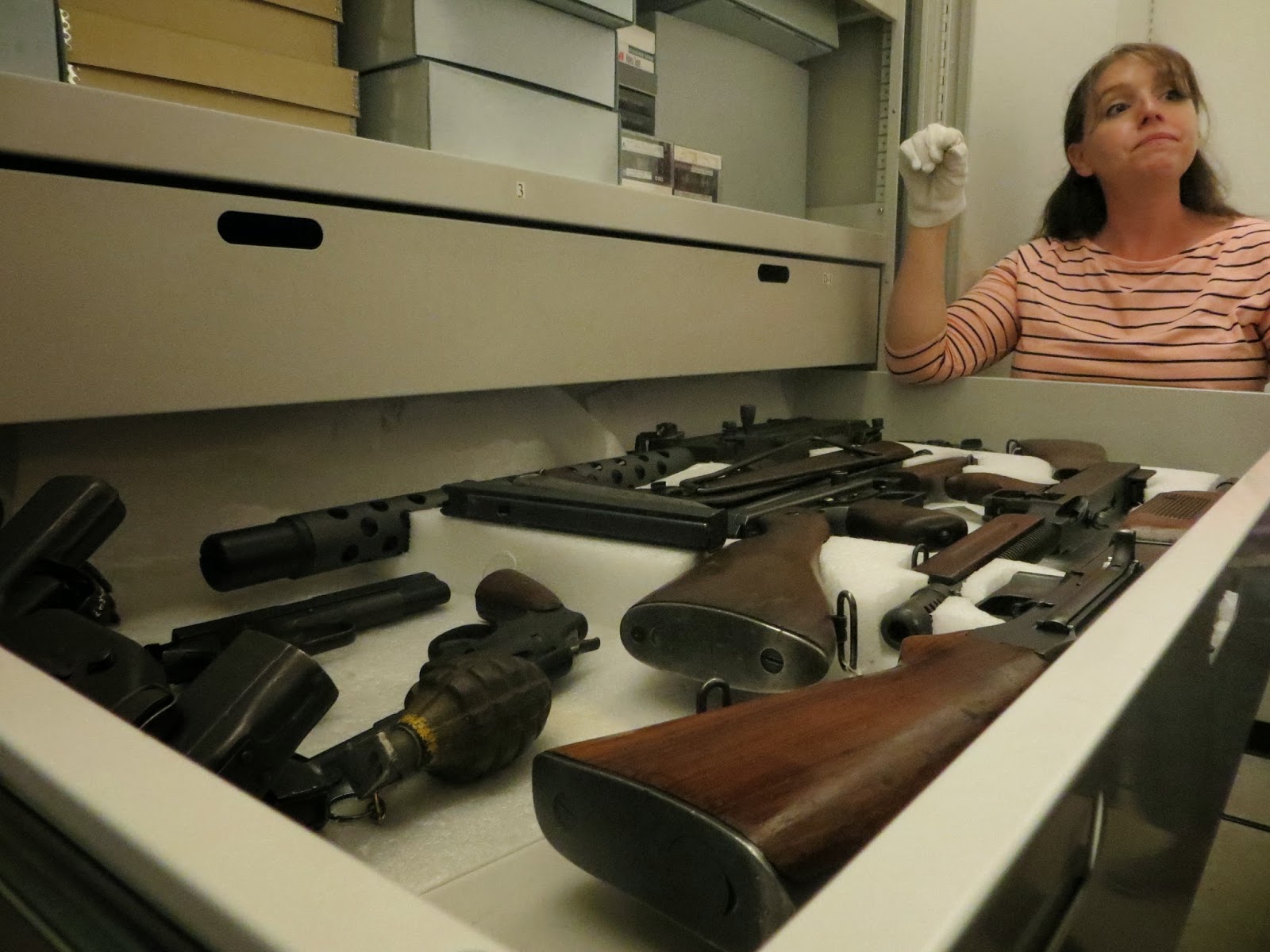
Our next few hours with Toni were the highlight of my “Behind the Lines” experience. After lunch, she took us up to the third floor which is solely the purview of museum staff and home to the vault. After being issued a set of white gloves, we were allowed into the space that houses ninety percent of the artifacts belonging to the museum. Toni showed us dozens of items including a piece of the USS Arizona, uniforms, footwear, and drawers filled with original (and for the most part fully operational) weapons (she informed that she has a very friendly relationship with her local ATF agents as a result). I worked very hard to contain my glee as I handled items that most will never get to see except behind glass; including my beloved STG-44 and MG-42.
Curator Toni Kiser showcasing some of the museum's world class artifact collection.
The Soviet drawer.
Molly appeared again and informed us it was time to head to the new Boeing Freedom Pavilion to experience the museum’s incredible collection of restored World War II aircraft (including a B-17 heavy bomber suspended 100 feet off the ground) and climb through the museum’s operational M4A3 Sherman Tank. Now, as a US Army Armor Officer, getting into the Sherman was a real treat. However, as someone used to the modern vehicles in the Army’s inventory, the Sherman was a real eye-opener. I get constantly made fun of as an incredibly short and skinny 19 series Soldier, and I had significant issues getting into the Sherman’s cramped interior. I can safely say that well over half of modern tankers wouldn't even be able to fit through the hatches on that thing and I may have uttered an inappropriate expletive or two wondering how the tankers of past took this vehicle into combat.
Me barely squeezing into the driver's hole of the M4A3 Sherman.
Sitting in the commander’s seat, I realized the shield on the 75 mm main gun was shaped to accommodate the commander’s shoulders to such tight tolerances that I (all five foot eight, 155 lbs of me) couldn't rotate my upper body to access the remainder of the turret. The loader does not have a separate hatch so that in the event the turret is disabled, he would have literally been hopelessly trapped inside, and after the requisite combat yoga required to access the gunner’s seat I realized just how crude the sights and optics were on tanks of this generation. I've been blessed enough to have been able to climb through a Sherman, a Tiger, and stick my head in a T-34. I can now unequivocally say my preference for Axis designs is totally justified. On a side note, I do have to apologize to Toni for accidentally rotating the turret while she and Annie were on the front slope (honestly, I didn't realize that the turret was unlocked and the manual traverse was also located on the gunner’s hand station). Luckily, she stopped me before I went more than a couple of degrees, but I can assure you I still feel very bad about this.
Curator Toni Kiser poses with Public History Bison on the M4A3 Sherman.
We then had to say goodbye to Toni and head to the new “Final Mission: The USS Tang Submarine Experience.” An extra that anyone can purchase when visiting the museum, it is an immersive experience where each person assumes a different role as a WWII submariner (my role was a throttle control technician in the engine room) during the famed USS Tang’s final mission. We received our briefing from the ship’s commander and then went to our battle stations to attack an enemy convoy. You have to listen to the commands given over the intercom and work your controls appropriately. Some guests had to reload torpedo tubes, adjust the helm, or work the weapons control stations. I’m sure Navy vets would get a real kick out this until the last few unfortunate moments when the ship is struck by its own defective torpedo and sent to the bottom.

After the Tang, Molly escorted us back to the Louisiana Pavilion where we met Volunteer Docent Barry Simon for our guided tour of the Pacific Galleries. Barry did another outstanding job of humanizing the conflict in the Pacific and in a particularly moving moment, choked up during his retelling of the Patten family, eight brothers and a father serving in the Navy during the early years of the war. Chosen by fate to be at both Pearl Harbor and the Battle of the Coral Sea, they all survived the destruction of the USS Nevada and the USS Lexington to finish the war together.

As the day wound down, we finally headed back to the Solomon Victory Theater to view the museum’s crowning experience, “Beyond All Boundaries,” a 4D movie narrated by Oscar Winner Tom Hanks about America’s journey through World War II. Annie and I had seen this on our previous visit to the museum and I can only describe it as, “World War II: The Ride.” It is an incredibly moving, immersive journey through history that emotionally captivates you through oral histories, large screens, and special effects. It’s an absolute must for history novices and enthusiasts alike.

Finally, Molly took us over to theStage Door Canteen for dinner and a show before finally said her goodbyes. After thanking her for all her hard work, we were treated to a wonderful meal where all the members of the tour group were able to discuss our experiences during the day and get treated to a viewing of “The Andrews Brothers,” the museum’s latest musical review. Performers skillfully brought the music and costumes of the '40s back to life in the guise of a USO show that suddenly finds itself without its stars on a South Pacific island.

As Annie and I walked back to our hotel room at the end of the day, both of us were tremendously impressed with the program the National World War II Museum put together. Molly was there every step of the way to make our visit a spectacular memory, Ronnie and Barry, our volunteers both helped bring new life to our tours of the galleries, and Gaston Andre let us see history getting rebuilt to its glory. Toni Kiser was absolutely outstanding and it was a real privilege to have one of the museum’s leaders take us through so many rare and beautiful artifacts. She also indulged Annie and I and let us see how a world class museum organizes its collection and constructs the experience for its visitors.

“Behind the Lines” is exactly that: A real adventure through the inner-workings of the National World War II Museum. To anyone with even a passing fascination with the world-changing events of 1939 to 1945, TAKE THIS TOUR. It is a gift you give to yourself. Plus, your contributions will help ensure that this fantastic museum and its staff will be able to keep telling the story of the Greatest Generation for many years to come.

Wednesday, March 20, 2013

Annie's Adventures in Tankland

This week finds me in Georgia for spring break and for Eric's graduation from the Maneuver Captains' Career Course. This proved a great opportunity for a family get-together, so the Muirheads and Moshers descended upon Fort Benning. As a special treat, some of us spent a couple of hours at the Armor Museum Restoration Yard. Since the Armor School moved to Benning from Fort Knox, the Army has assembled an extensive Armor collection at Benning with the goal of creating a National Armor and Cavalry Museum to rival the phenomenal Infantry Museum (review to come!). Unfortunately, a severe lack of funding has put a serious damper on these plans. The only workers we saw there today were Marines doing volunteer hours as part of whatever school they're attending. We didn't encounter anyone in charge, but no one questioned a captain in uniform walking around with three men in coats and ties (plus me). I wish someone had been around, because I would love to talk about tank restoration in the context of what I've learned about museum conservation this semester. The scale of this place was simply incredible - tanks as far as the eye could see from around the world. The real treasures are kept inside, but even those show signs of damage from the elements. As awesome as it was to be so close to such amazing artifacts, it's pretty sad to see them rusting away without homes. Below is a slideshow of my pictures from today. If you think the public deserves to see these vehicles preserved and interpreted, please visit the National Armor and Cavalry Heritage Foundation and consider making a contribution to the museum's future.

Wednesday, February 20, 2013

El Paso Holocaust Museum and Study Center

I wrote this review fall 2011 for one of my public history courses. I revisited the museum in January 2013, during which time I took the pictures included. At this time, a multimedia exhibit called "The Memory Project" had taken the place of the introduction video. I observed no other changes to the museum.
The El Paso Holocaust Museum and Study Center
As I approached the El Paso Holocaust Museum, one question found its way into the forefront of my thoughts: what on earth is a museum about events that happened a world away doing in El Paso, Texas? The answer became clearer as I began my tour. Prior to entering the galleries, visitors watch a short introductory film, which covers the Jewish experience prior to the Holocaust and the story of the museum's founding. Henry Kellen, a survivor of the Holocaust, founded the museum in 1984 as a single room in the Jewish Community Center, using his personal story and collection of artifacts. A plaque in the memorial section of the museum reveals that his wife, also a survivor, died one year prior to the museum's founding. It's possible that her death inspired Mr. Kellen to honor both the dead and the survivors by teaching a new generation about the atrocities that swallowed Europe in the twentieth century. In 1994, he moved the museum to its own building, which tragically burned in 2001. The present museum opened in 2007.
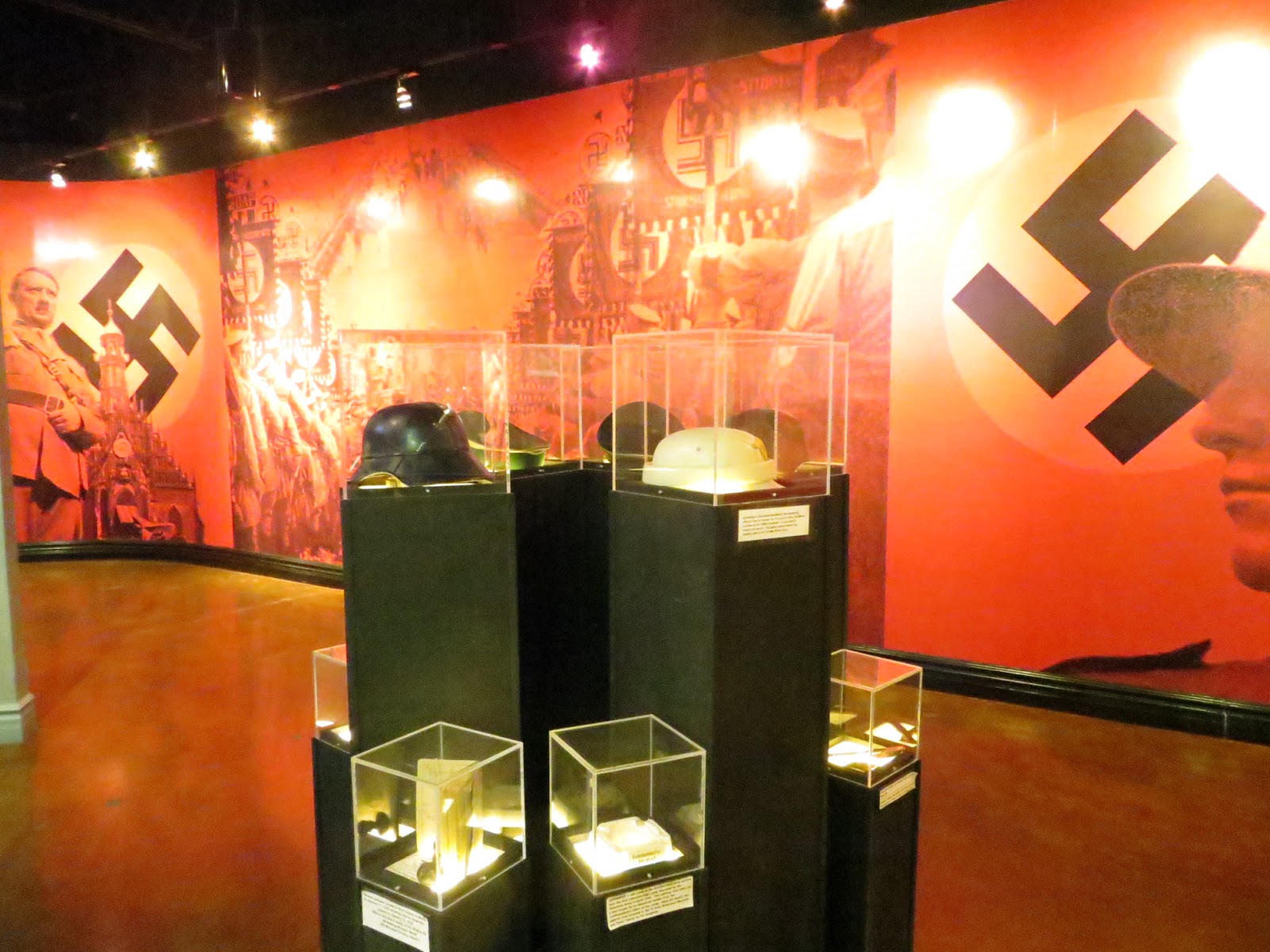
A couple of cabinets with a bunch of Nazi artifacts, many of which don't
have any labels.
This very personal museum tells a story about the millennia of oppression and persecution faced by Jews, which culminated in the twentieth century with the Holocaust. As the museum lost many of its original artifacts  in the 2001 fire, it relies on video, timelines, and dynamic environments convey its narrative. I followed the chronological path of Germany's Jews as Hitler's rise to power shattered the illusion of peace after ages of struggle. From there, my path continued past the devastation of Kristalnacht, through deportations and ghettos, to the concentration camps. My tour concluded with the liberation of the camps and memorials honoring those who died, those who lived, and those who helped others escape death. The introductory video continued throughout the galleries, explaining the pertinent events with segments like "The Rise of Nazism," "Deportation from the Ghettos," and "The Final Solution." Besides the timelines, I saw little text to augment these videos, which used still photographs and narration a la Ken Burns. My impression was that this museum wanted visitors to experience history, rather than read it.
The jarring transition into Nazi Germany.
The construction of the actual galleries contributed greatly to the active experience. My tour began conventionally, staring at an example of an twentieth century Jewish dining room behind a glass case. Very little distinguished it as "Jewish," suggesting that the Jews had finally found acceptance in European society after millennia of persecution. A helpful timeline on the opposite wall detailed this lengthy struggle. This portrayal of normalcy enhanced the shock I felt upon entering the next gallery, where the walls featured large images of Adolf Hitler and crowds of uniformed Nazis tinted a vibrant and jarring red.The center cases enclosed Nazi headgear, lit from below, adding to the sinister feeling in the room. My tour through Nazi Germany continued with a wall of reproduction anti-Semitic propaganda posters, cartoons, and advertisements. Now in a German street, I saw a shop front destroyed during the violence of Kristalnacht.
Kristalnacht.
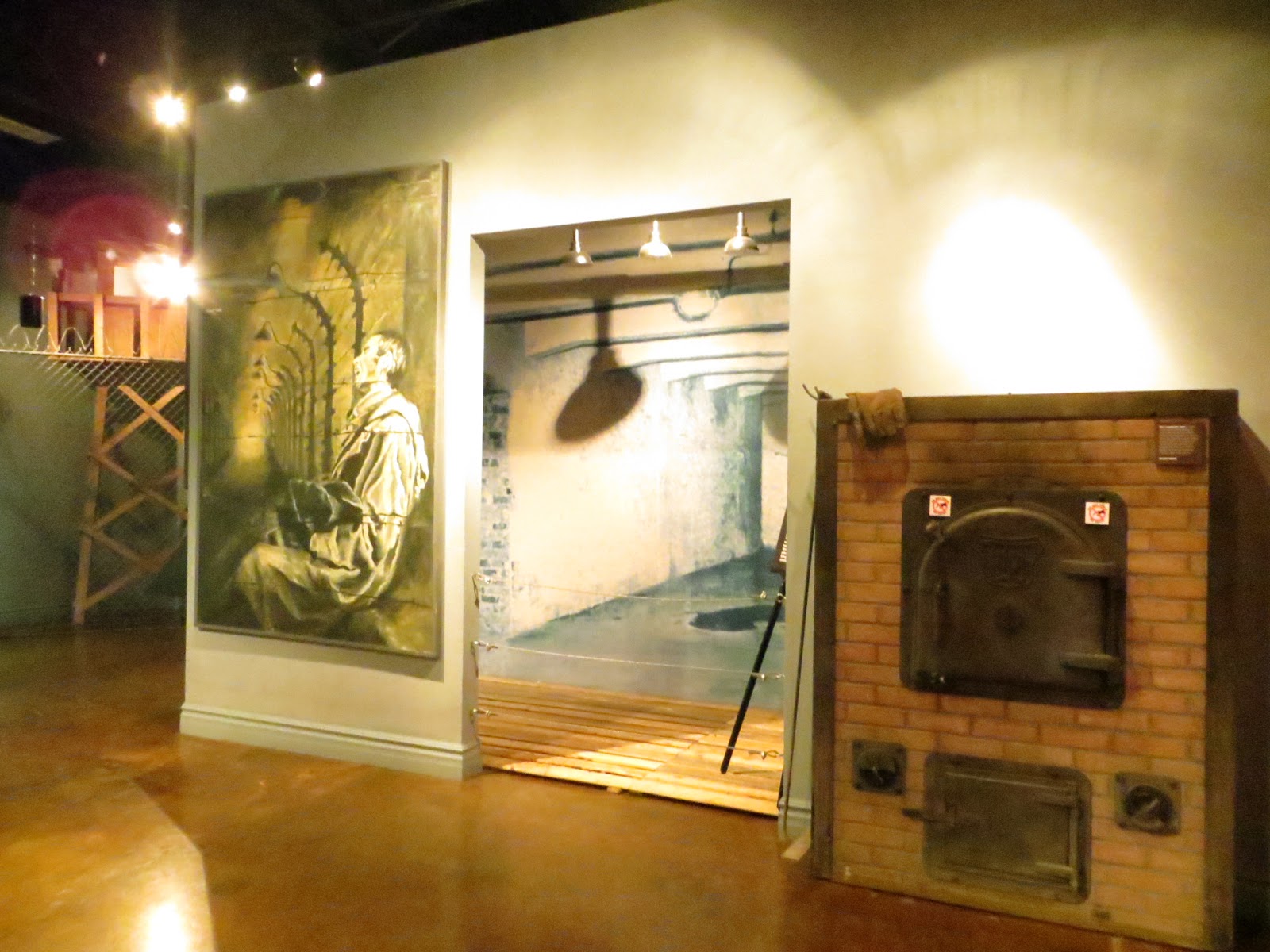
Unfortunately, a cartoony quality to this environment evoked thoughts of Disneyworld rather than disaster. Past Kristalnacht, I saw a train car protruding from the wall of the next gallery. If I hadn't recognized it already, at this point I found it impossible to deny the influence of the United States Holocaust Memorial Museum, which opened in Washington D.C. in 1993. Upon my last visit to Washington, I had walked through just such a train car. On the other side of this train car, a staircase led me down to the entrance to a concentration camp. A guard tower with an obviously fake machine gun protected a small gate bearing the words "ARBEIT MACHT FREI." Like the Kristalnacht gallery, the small scale of these otherwise imposing structures made them almost comical. This gallery also included the facade of a barracks, an example of a gas chamber, and a reproduction of a crematorium oven. The story focused on the dehumanization and murder of prisoners in concentration camps. Any amusement I felt at the tiny gate and tower dissipated quickly. The rest of the museum serves as a memorial. The next gallery talked some about resistance, but an entire wall commemorated those who saved others from death, declared "The Righteous of the Nations" by Yad Vashem, the holocaust Martyrs' and Heroes' Remembrance Authority. A few moments were spent on the liberation of the camps, where the museum found the opportunity to make a local connection. The images and stories of liberators from El Paso adorned the last wall in the gallery. The final room contained a memorial to both the dead and the survivors. One last local connection recognized all the survivors who settled in El Paso after escaping Europe.
A replica train car, similar to that at the United States Holocuast Memorial
Museum in Washington DC.
Quite plainly, this museum does not tell the entire story of the Holocaust, but the Jewish experience of the Holocaust. The videos occasionally mentioned Hitler's other victims as statistics or in passing, but every time the narrator referred to prisoners or victims as a group he used the word "Jews." This presents a rather narrow view of the Holocaust, possibly encouraged by the very personal nature of the museum. It does not represent an organization or government, but one man's desire that people remember what happened to his people. The narrative also makes no effort to place the Holocaust in the greater context of genocides throughout history. The final video segment went so far as to call it a unique event. Both that segment and the introductory film ask the question "why?" intending that the visitor ruminate on how people could have allowed or committed such monstrous acts. However, I felt that the museum answered their own question in regards to the Holocaust: Germany's vulnerability after the First World War created a power vacuum in which Adolf Hitler found it easy to convince people to follow him.
The display case of camp artifacts and the model guard tower.
I think any real explanation is much more complicated, but the museum did itself a disservice by not expanding its narrative to at least mention other genocides. One holocaust can be easily explained as an aberration, but a long history of mass murder forces visitors to ponder the "whys" and "hows." I found it surprising that the museum did not use this tactic to affect my emotions after making such obvious attempts to evoke emotional responses throughout the exhibits. Poetry, sculpture, and artwork all found places in galleries, where they were clearly meant to impact visitors emotionally (e.g. a statue of a suffering child next to the boxcar). I heard other attempts at sensationalism as my visit coincided with a field trip from a local high school. For the most part, I made my way through the museum alone, but after the boxcar I caught up with their group long enough to listen to the docent for a few minutes. I grimaced as I heard him describe how the Nazis made lampshades, book covers, soap, and other goods out of human skin and fat. As there is no historical evidence to support these claims, I felt a bit miffed that he passed this information along as fact to the unsuspecting group of students. The museum's narrow focus on Jewish suffering takes the visitor through an emotional journey, which loses some impact without further historical context.

After hearing about the devastation wrought by fire in 2001, it did not surprise me to find the museum lacking in material culture. What does remain came from the personal collections of Holocaust survivors in El Paso, who generously donated their memories or returned to the camps to collect new artifacts. However, the museum did not incorporate them well into the narrative shaped by video and environment. One or two artifacts found homes in other galleries, but the bulk of the collection resided in the sections on the rise of Nazism and the camps themselves. This first gallery includes several cases with a veritable hodge-podge of Nazi memorabilia. China, badges, uniforms, books, documents, trinkets, and weapons lay side by side with little explanation. Most objects have no explanatory text at all, much less any cohesive organization or narrative. I saw this jumble repeated in the camp gallery - a variety of relevant artifacts flung together in a case haphazardly. It seems to me that the museum divided their surviving collection into two categories and threw them in cases. This museum needs to work on incorporating artifacts into the narrative to support its flashy videos and galleries.

The final stop on my visit to any museum is the gift shop or bookstore. I think that the gift shop is just as much part of the museum as the galleries, because it is from there that visitors find tangible objects to help them remember or further explore what they learned. Therefore, an excellent gift shop should expand from the museum's focus to other relevant topics. The El Paso Holocaust Museum's shop boasted a small selection of souvenirs, books, and DVDs, which support its focused narrative. Almost all the books retold the experiences of Jewish groups or individuals during the Holocaust, including volumes appropriate for both children and adults. Of the other topics covered, I found one volume on other victims of the Holocaust, one book on Japanese internment camps, two books on Rwanda, one on genocide in general, and one on Holocaust denial. The collection of DVDs contained slightly more variation in genre and country of origin, but focused on the Jewish experience with one notable exception. Downfall, a 2004 German film, which witnesses Hitler's last days through the somewhat revisionist account of his secretary, Traudl Junge. Its presence among the several different versions of Anne Frank's tragic story continues to intrigue me.
Holocaust survivors who settled in El Paso.
Overall, I enjoyed my visit to the El Paso Holocaust Museum and Study Center. Its narrative, though narrow or somewhat exclusionary in its focus, guided me through a clear and emotional history of Jewish suffering. I appreciated the modern influence of the United States Holocaust Memorial Museum in creating the museum's environment and structure, but I think this museum could benefit from revisiting old fashioned museum work. Artifacts need more text and should contribute to the narrative, facts and figures need support and documentation, and all the galleries could use more text for those of us who want more information. The museum does a good job at incorporating personal narratives at the beginning and end, but the bulk of the story features no such personal connection. Nevertheless, this museum offers a reasonable introduction to the events of the Holocaust, though I hope most visitors seek supplemental information. I completed my thorough tour in an hour and a half, making it an easy trip for even the most impatient museumgoers.

Tuesday, January 22, 2013

Hands-On History

It's been impossible to ignore the gun control debate currently raging across this country - I see it on the news, on Facebook, and plastered across tumblr. However, one aspect of gun culture rarely addressed in this feeding frenzy is that of historical firearms. Eric and I both collect those weapons which have had such an impact on the world's most recent history. A couple of our examples predate 1900 and are therefore legally antiques, not firearms. The weapons used in the twentieth century's defining conflicts, though, are regulated like any other firearm despite obsolescence in modern conflict. It is far too easy to argue that these weapons should be demilitarized and kept only for display purposes in museums and such. (Eric would hate that I'm even voicing this idea. While I was interning at the Fort Bliss and Old Ironsides Museums, the curator allowed him some time in the armory. The sight of a half dozen demilitarized Thompsons almost brought him to tears.)

Some historical firearms are purchased as "wall-hangers," but I think relegating all artifacts to this future deprives historians of their value. During one of the first sessions of my graduate "Craft of History" seminar, we conducted an exercise in identifying primary and secondary sources. When we came to a uniform jacket from the Mexican-American War, one student said, "but that's an artifact." Three or four of us in unison proclaimed "it's still a primary source!" Artifacts provide a great resource for historians, as demonstrated by scholars like Laurel Thatcher Ulrich. Firearms are no different and offer the additional opportunity for what I term experiential history. This process allows the modern historian to glean a sense of the past through the use of an artifact or the application of practical research. My experiences have mostly involved weaponry* and sewing, but other opportunities abound. During our years at William & Mary, Colonial Williamsburg's relationship with the college offered many such to my friends and I. Living history is the most common forum for this kind of history as interpreters immerse themselves in the daily minutiae of the past. Emily spent a semester in the apothecary's shop; Abigail wrestled with colonial cookware for a few months in the kitchens of the Governor's Palace. As part of my seminar on the "Early Modern Book," I got to try working the press at the Printing Office. My page turned out fairly well, but pulling the operating handle lifted my full weight off the ground.
My British surplus FN FAL.
While I don't claim that firing a historical weapon gives you omniscient understanding of the person(s) who used it in the past, it can enrich your impression of those individuals with details that don't come across in written sources. Handling a weapon in an afternoon can hint at where shooters developed calluses, bruises, or soreness. Long-term projects can examine change over time, examining how extended use affects both the individual and the artifact. How accurate is the firearm in various circumstances? How reliable is the weapon in different environments? What kind of maintenance is necessary is necessary to keep the firearm fighting fit? The controlled environment of the shooting range does not offer the same experience as combat, but the observations made can help explain any technical or physical reasons why an individual acted in the past in a certain way. What an individual learns about their equipment affects their decision-making, contributing to the actions that become history.
Me again, firing Eric's M1903 Springfield.
I haven't spent an extended amount of time on this sort of project, but I have had a couple of experiences that hint at it's usefulness. A few years ago, Eric taught me how to shoot the musket from his Revolutionary War reenacting days. He had prepared the cartridges, but I was responsible for all other parts of the process: removing each round from the cartridge box, pouring powder in the flash pan, ramming the rest of the cartridge down the barrel, and firing the musket. The thing was almost as tall as I was and proved pretty unwieldy, though at 5'4" I'm probably not abnormally short for colonial soldier. I had trouble reaching to get the ramrod down the barrel and probably would have hit someone with it had I been standing in ranks. I also manged to dump the powder out of the flash pan onto the ground a couple of times. It would have required an extensive amount of drill to prepare me for combat in Washington's army. Simpler observations include the way the grip on a Luger irritates my hand, the difficulty of firing most historical weapons as a left-handed shooter, the kick of a 1903 Springfield compared to that of an M1 Garand, and the finickiness of a Mosin-Nagant bolt. Speaking of the Mosin, I wasn't present for its most absurd moment. Eric and our friend Tim were enjoying a lovely day at the range when the Mosin fell apart in Tim's hands for no apparent reason. There were no immediate risks to the rifle's failure in this environment, but the frustration could be translated to any of the battlefields where the Mosin-Nagant saw combat.

I briefly mentioned reenacting above, but those weapons used by reenactors of the American Revolution and Civil War are reproductions of antiques. Twentieth Century reenacting requires different tools entirely.
Me (age 6?) and Dad  at a museum in Quebec.
During the past decade, my Dad (yes, history is a family business for me) has expanded his repertoire from two Civil War impressions to include an Irish Volunteer from 1916-1923, an officer with the 1st Battalion Royal Ulster Rifles in WWII, and a member of French Resistance. For these impressions he has spent tireless hours finding appropriate firearms which proper dates and matching markings. He's also gone to a great deal of trouble to accessorize these examples.
Dad as a 1919-1923 Irish Volunteer, carrying the SMLE and wearing an
original South African Model 1905 five pouch bandoleer.
The Irish Volunteer carries a .303 SMLE No 1 Mk III, Lithgow 1914, to which he has added a sling, reproduction bayonet and scabbard, 1914 Enfield brass oil bottle and WWII Australian pull through for cleaning. For him, this collection of artifacts complements the rifle as an educational tool, allowing him to present a thorough and accurate impression. He and Eric fired the SMLE over Thanksgiving, providing more experience for my Dad to draw on in conveying the experience and  identity of an Irish Volunteer.
Eric checking the aim on the SMLE.
What does any of this have to do with gun control? Basically, there are valid reasons for the ownership and use of historical firearms, which many legislators and commentators have not acknowledged. While gun buybacks have proved enormously successful in getting unwanted, unused, and possibly illegal firearms off the streets, most don't distinguish between mass-produced modern pieces and historical treasures. A police officer in Hartford, Connecticut saved one such artifact from destruction. The original German STG-44 is a lucky survivor. How many other museum pieces with not be so lucky, forever depriving historians of invaluable artifacts? I don't have any answers, but I believe we should consider the historical value of firearms before haphazardly banning or destroying them. From what I can see, we need new thinking and new ideas about gun control, developed by those who understand the nuances of guns, gun culture, the constitution, and the realities of crime. I fear that simply rehashing old ideas won't have the needed effects, will further the great divide within this country, and destroy important parts of history from around the world.
Me, during the month I had blue hair, firing a reproduction  GSG STG 44,
produced by American Traditional Imports and chambered in .22 LR.
*and not just guns! In high school I studied Rapier and Short Sword at the Virginia Academy of Fencing.

Saturday, October 13, 2012

The National WWII Museum

Last weekend I took a much needed break from Grad School to visit New Orleans with Eric and the rest of the Russian House Exiles. One of trip's highlights was definitely our time spent at the National WWII Museum. As I understand it, this museum was originally founded as the National D-Day Museum, the brainchild of Stephen Ambrose and the History Channel, but was rebranded and expanded as the National WWII museum after Hurricane Katrina threatened to shut it down permanently. The museum's complex currently occupies two city blocks and is still growing. We had some trouble finding the actual museum entrance and had to ask for help in one of the three museum stores. We felt slightly better about this when we helped out several other visitors who had the same problem.

Once inside, is it sad that I was a little underwhelmed by their presentation of a C-47? Besides that, they had one Sherman tank and a Spitfire in the pavilion that holds the vehicle collection. That's a pretty sad assortment if you ask me. Even the Fort Bliss and Old Ironsides Museums has a T-34. Expansion suggestion #1: This place needs a tank park.
Admission to the museum was a little steep. Our group lucked out since most of us had student and/or military IDs, warranting a decent discount. We paid $12 to get into the museum rather than the steep $21 for adults. However, the museum does offer free admission for uniformed military personnel and WWII veterans. Tickets in hand, we skipped the introductory videos and marched straight up to the exhibit beginning. The first display set the tone for the rest of our visit, demonstrating an aspect of museum work that this place really excels at: the visual display of information. You turn the corner into the Home Front gallery, where the story begins, and BOOM you instantly see the disadvantage of American forces at the beginning of the war.
Lined up in front of the corresponding national flags, little army men represent the sizes of the various armies. Pretty neat stuff and very easy to grasp the meaning without reading every little piece of text.This first section of the museum depicts the mobilization of the home front to support the war effort, including the development of industry and enlargement of the US army. It was a little strange to encounter the home front before the war had even started exhibit-wise, but I guess it allowed the narrative to leave the United States behind to focus on the fighting.

From the Home Front, visitors walk upstairs to the European Theater. Since this was previously the D-Day Museum, anyone familiar with World War II will be surprised to find that the exhibits start late in the war with preparations for the invasion of Normandy. The museum's mission statement reads that "the National WWII Museum tells the story of the American Experience in the war that changed the world- why it was fought, how it was won, and what it means today - so that all generations will understand the price of freedom and be inspired by what they learn." Very clearly, the museum strives to tell the American story of World War II, therefore all that stuff that happened before the US entered the war isn't all that relevant. They do follow the European Theater through the end of the conflict and they've added a section on the Pacific Theater, but US operations in North Africa receive almost no mention. Naturally, the museum omits the Eastern Front and all that stuff that happened before the US got involved. However much I might want them to tell the whole story of WWII, not doing so is completely in keeping with their mission statement.

So...maybe they should revise their mission statement.

Regardless of huge gaps in the narrative, they really have done some fantastic museum work. Here are some of my favorite parts:
This recreation allowed Tim and Eric to reenact The Longest Day complete with sound effects. I really enjoy it when museums are able to create environments within their exhibits that really transport the visitor to a different time or place.
 This was probably one of the best displays in the entire museum. The lines on the map connect an individual soldier to his location during the invasion. The inclusion of his picture with his story helps the visitor connect with him as an individual, and then there's an artifact that connects to each soldier. This is just so good on so many levels. I might have squeed a bit.
 Eric and I agreed that someday we want to decorate a nursery like this. Do you remember what I said about the visual representation of information? Well, there's the force attacking at Normandy. The visitor doesn't need to read anything to see the size and variety of the force deployed against the Nazis.
 Once you've landed in Normandy, this environment sneaks up on you. The ancient hedgerows in this area of France allowed German forces to easily conceal shooters, which is exactly what the museum has done here. One of the guns is fairly obvious to alert you to their presence, but then it takes a few minutes to find all the barrels aimed at you.
 These booths are integrated throughout the museum. Each one offers four two-minute oral history clips that connect topically to the gallery around them. It's a great way to add a personal dimension to the narrative without trapping the visitor for 15+ minutes or obstructing traffic.
 During my visit, our group got split up as some of us moved faster through the galleries. As explanation, I present the following exchange:
Evin - How did you guys get so far ahead of us?

Tim - We didn't have to read anything, we had Eric.
My husband Eric, the walking encyclopedia of military history.

The museum also had a special exhibit on entitled "Deadly Medicine: Creating the Master Race," sponsored in part by the United States Holocaust Memorial Museum. It's so nice to see the various private museums working together.

We had lunch after our visit at the museum's restaurant The American Sector, which had a very tasty menu offering a mix of local dishes and items reminiscent of wartime rationing. They also had a pretty nice drink list. For a snack or a quick meal, the museum also houses a Soda Shop. The Stage Door Canteen offers live entertainment at Brunch and Dinner shows. Seriously, this place offers the complete 1940s experience.

On Sunday, while part of the group went to mass, Eric and I came back to the museum to see Beyond All Boundaries, "the 4-D Experience Featuring Tom Hanks." Eric just can't say no to Tom Hanks and I was curious. It was awesome and honestly worth the extra admission cost. Eric described it as "World War II: The Ride." According to the museum's website, they're currently hiring theatre and A/V technicians. Very tempting. Our return trip also meant that we got to check out the third museum shop. The three shops overlap in their stock, but they all carry a good variety of books, DVDs, swag, toys, and clothes. It was pretty cool that they actually had dresses from Stop Staring! on sale. Even cooler? GREMLINS!!! How had nobody ever shown me Gremlins before?!?!?! To prevent you from a similar catastrophe, I offer the following: [EDIT: "Gremlins from the Kremlin" is no longer available, but here's another Bugs Bunny cartoon with a Gremlin.]

One thing that was also clear from the museum was that they have a very strong volunteer program. Members of the Youth Victory Corps (middle and high school students) were stationed throughout the galleries with artifacts that you could touch and play with. Also, the museum is taking advantage of one very important asset that won't be around forever: World War II veterans. 
Right near the front entrance, this set up enables veterans to come in and volunteer to share their experience of the war. We didn't get the chance to talk to any of the volunteers while we were there, but the program offers a great opportunity for both visitors and veterans.

Overall, this museum has some great things going for it that make it well worth the visit, even though the narrative skips over some important aspects of the war. Like Africa. Or the Eastern Front. If you don't have an Eric with you, allow 2-3 hours for the exhibit galleries. If you have time, definitely check out the movie and grab a bite to eat!

Tuesday, August 14, 2012

Get to the Chopper: July 13 - 19

This next week continued the transcription holding pattern I'd established during the previous week. I worked from home on Friday to do laundry and then headed to the Vic after dinner. The after party that night ended up at Paul's, where dancing ensued. Apparently, I wore myself out as I slept for most of Saturday. That was a Trough night, so I'm glad I was well-rested as I had plenty of energy for more dancing, though no one had much energy after the Trough closed. A few of us went to Paul's, but we just sat around for a little while. The rest of the week really was just endless transcription - at the museum during the day and at home in the evenings. I did finally get back to the Falklands 30 exhibit to take pictures, though. I also checked in with the library and discovered that they don't actually collect fines - they just want the books back. That was a stroke of good luck as I had been late returning several items.
The first part of the exhibition. It continued to follow the invasion chronologically.
This area contained one of my favorite parts. That old radio concealed an iPod dock which played snippets of Patrick Watts' broadcast of the Invasion, when he stayed on air all night.

The British soldier caused all kinds of trouble as we simply could not get him fat enough. Also, his boots were too small.
I realize now that I got confused in my last post. I confused and combined two different Steak Nights. The after-party at Steve's was definitely on July 11, but it followed a perfectly normal and timely Steak Night with him, Mike, and Miguel. July 18 was the Steak Night when everyone showed up late. How do I know this? Because I went for a helicopter ride the next day. I had asked Gary a couple of weeks before about the possibility of tagging along on a CHC flight. He said it didn't look good and there wasn't anything scheduled before I left, but at this Steak Night he said there was a flight the next day that I could go on if the weather held. The next morning the skies were clear and the flight was a go. My hosts drove me to the Stanley Airport and I hung out on the tarmac before it was time to go. This was just a short test flight over Stanley and back, but it was pretty awesome. I'd never been in a helicopter before and as soon as we landed I wanted to go again.
The Super Puma and I.


East Stanley - I actually did an interview at one of those houses.
The Lady Liz